Most leadership training does not change behavior. A manager can finish a workshop on feedback, nod along to every module, and still freeze when a direct report pushes back on a performance review the following week. Knowing what good leadership looks like and being able to do it under pressure are two different things, and only one of them is built through practice.
This guide explains what leadership development simulations are, why they work when traditional training stalls, and how to tell a business strategy game from a simulation that actually changes how a manager shows up in the moments that matter.
What are leadership development simulations?
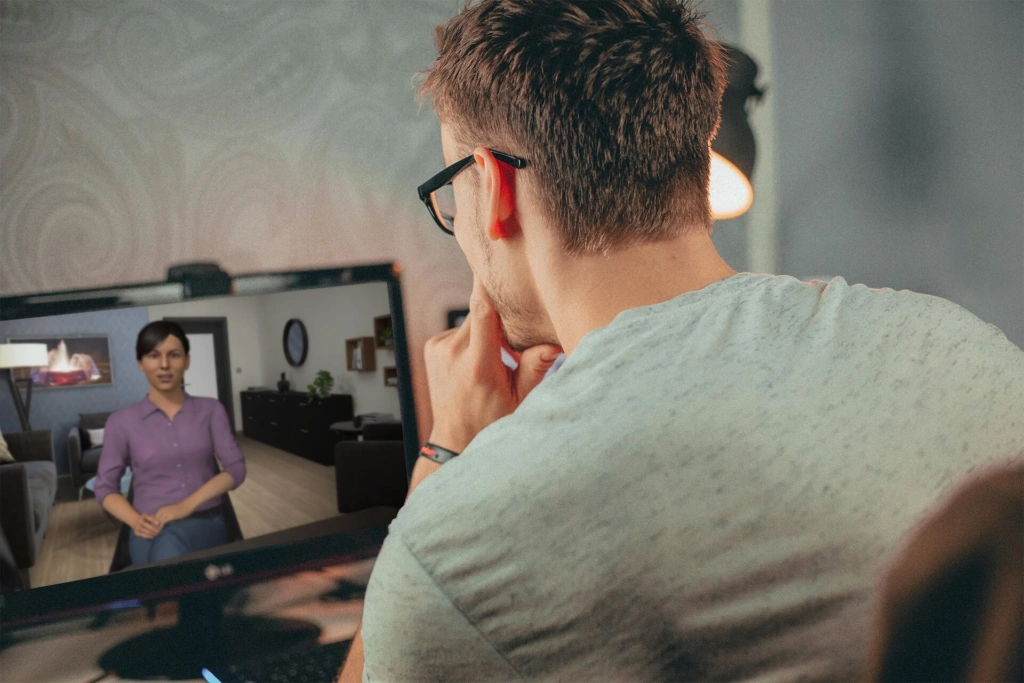
Leadership development simulations are immersive, experiential learning experiences where managers step into realistic, high-stakes scenarios and make real decisions under pressure. Rather than watching a video or discussing a case study, the learner responds in real time, manages conflict and handles tough conversations before the stakes are real, and gets specific feedback to improve with each repetition. In short, they turn leadership from something people study into something they practice.
In plain terms: a simulation lets a manager rehearse a hard conversation or a high-pressure decision as many times as they need, with a realistic avatar on the other side, until they can handle it with confidence.
The strongest simulations share a few common elements.
| Element | What it means |
|---|---|
| Realistic scenario | A situation that mirrors a real workplace challenge, not an abstract puzzle |
| Active decision-making | The learner drives the outcome through their own choices and words |
| A responsive counterpart | A person or AI-driven character who reacts the way a real colleague would |
| Specific feedback | Objective input on what the learner actually did, not a generic score |
| Repetition | The chance to try again and refine the approach |
Why most leadership training does not change behavior
The gap in leadership development is rarely a knowledge gap. Most managers already know they should give clear feedback, listen before reacting, and stay calm under pressure. The gap is the distance between knowing that and doing it when a real person is frustrated, defensive, or upset in front of them.
Traditional training lives almost entirely on the knowing side. Lectures, slide decks, and case studies transfer information well, but information is not a skill. A manager who has read about difficult conversations has not had one. The first time they practice is on a real employee, in a real moment, with real consequences.
Consider a newly promoted manager whose direct report disputes a performance rating. In a workshop, that manager can describe the ideal response. In the actual meeting, their heart rate climbs, the employee gets emotional, and the carefully learned framework evaporates. They default to whatever instinct they brought into the room. Practice-based learning closes that gap by moving the first rep out of the real world and into a simulation, where a misstep is a learning moment instead of a damaged relationship.
How leadership development simulations work
Leadership development simulations work by running learners through a short, repeatable loop that builds skill the way real experience does, only faster and without the risk. At Mursion, that loop follows a simple progression: learn, practice, master.
- Step into a scenario. The learner enters a realistic situation, such as coaching an underperformer or announcing an unpopular change, and takes on the leader’s role.
- Respond in real time. There is no script. The learner has to decide what to say and how to say it as the conversation unfolds and the other person reacts.
- Receive specific feedback. After the session, the learner gets concrete input on what worked, what did not, and what to try differently, drawn from what they actually said and did.
- Practice again. The learner runs the scenario again with their new approach, reinforcing the behavior until it holds up under pressure.
Because the counterpart responds dynamically, no two runs are identical. A manager who practices a layoff conversation five times has navigated five different emotional reactions, which is far closer to the unpredictability of real leadership than any single role-play exercise can offer.
The moments that matter: where simulations make the difference
Leadership is decided in a handful of high-stakes interpersonal moments. These are the conversations and decisions that shape trust, performance, and retention, and they are exactly the moments managers get the least practice in. Simulations let leaders rehearse them on demand.
| Moment that matters | What makes it hard | What practice builds |
|---|---|---|
| Delivering tough feedback | Fear of damaging the relationship or demotivating the person | Clear, direct delivery that stays constructive |
| Performance review pushback | Emotion and disagreement in real time | Composure and the ability to hold a fair line |
| Leading through change | Skepticism, anxiety, and low buy-in from the team | Messaging that builds confidence and commitment |
| Re-engaging a disengaged report | Reading what is really going on beneath the surface | Curiosity, listening, and a path forward |
| Navigating conflict | High tension and competing interests | De-escalation and a focus on shared goals |
A manager who has practiced these moments arrives ready. They have already felt the discomfort, tested their approach, and learned what works, so the real conversation is a second attempt rather than a first.
Business simulations vs. interpersonal simulations
Not every leadership simulation builds the same thing, and the distinction matters when you are choosing where to invest. Many well-known leadership simulations are business strategy games: teams compete to run a company, manage a budget, or summit a mountain, building decision-making and collaboration skills along the way. They are valuable for strategic thinking and team alignment.
Interpersonal simulations focus instead on the one-to-one human moments of leadership. The skill being built is not how to allocate resources, but how to communicate with a person.
| Dimension | Business and strategy simulations | Interpersonal simulations |
| Skill focus | Strategic decisions, financial acumen, team coordination | Communication, feedback, difficult conversations, human skills |
| Typical format | Team-based game or case, often facilitated in a cohort | One-to-one practice with a realistic person or AI-driven character |
| What the learner practices | Choices and trade-offs | Words, tone, and real-time response |
| Best for | Strategic alignment and business judgment | Everyday people-leadership and interpersonal skills |
Both have a place. If the goal is to develop managers who lead people well, the interpersonal simulation targets the moments that matter most in their day-to-day work.
The benefits of simulation-based leadership development
Simulation-based leadership development delivers advantages that traditional formats struggle to match.
- Confidence before the stakes are real – Leaders walk into hard conversations having already had them, so they show up ready rather than rehearsing with a real employee.
- Behavioral change that transfers – Practicing the actual behavior, not just learning about it, is what makes new skills hold up under pressure.
- A safe space to fail – Mistakes in a simulation are feedback, not consequences, encouraging leaders to take risks and refine their approach.
- Objective, specific feedback – Learners see what they actually did and get concrete guidance, rather than a generic completion score.
- Scale without scheduling bottlenecks – Practice-based simulations can reach managers across an organization, on their own time, rather than gathering a cohort for every session.
- Higher engagement and retention – Active participation keeps learners involved and helps insights stick far longer than passive content.
Frequently asked questions
What are leadership development simulations?
They are practice-based learning experiences that put leaders into realistic scenarios where they make decisions and handle conversations in real time, then receive feedback. The goal is to build skills through practice rather than to transfer information through lectures.
Do leadership simulations require a VR headset?
No. Virtual reality is one way to create an immersive experience, but many simulations run through a standard web browser with no special hardware. Mursion’s simulations, for example, create realistic interactions without requiring a headset, which makes practice accessible at enterprise scale.
What skills do leadership development simulations build?
They are especially effective for interpersonal skills such as giving feedback, holding difficult conversations, leading through change, and managing conflict. Business and strategy simulations also build decision-making, financial acumen, and team coordination.
How are simulations different from role-play?
Traditional role-play depends on a colleague improvising a character, which can be inconsistent and uncomfortable. Simulations provide a realistic, responsive counterpart and structured feedback, so every learner gets a consistent, repeatable experience and objective input on their performance.
Are leadership simulations effective for new managers?
Yes. New managers benefit the most, because simulations let them practice high-stakes conversations before they face them with a real team. Practicing first means their real conversations are a second attempt rather than a first.
Lead with practice, not theory
As AI makes technical knowledge table stakes, competitive advantage increasingly depends on how people lead, communicate, and work together. Those are the skills that get built through practice, not slides.
Leadership development simulations give managers the reps they need to handle the moments that matter, so they show up ready when it counts.