You’ve invested in leadership development. The workshops. The online platforms. The off-sites. Completion rates tick along, calendars fill up, and somewhere along the way, you’ve probably noticed the pattern: programs are delivered, but your managers are still struggling with the same conversations they were before.
If that feels familiar, you’re not alone. It isn’t a content problem. The material itself is more available and stronger than ever.
What’s missing is practice.
Immersive leadership development closes that gap. It puts leaders in realistic scenarios where they can rehearse the hardest parts of their job before those moments become real.
This guide walks through why traditional training falls short, what immersive leadership development looks like in practice, and how to build a program that actually transforms leader behavior.
Immersive Leadership Development at a Glance
| What it is | A practice-based approach to leadership training where leaders rehearse high-stakes conversations in realistic scenarios before those moments happen in real life. |
| Who it’s for | L&D leaders building leadership capability across their organization, especially for first-time managers, front-line leaders, and emerging high-potential talent. |
| Skills it builds | Confidence, adaptability, constructive feedback, conflict resolution, empathy, clarity, coaching, change management |
| Why traditional training struggles | Knowing a skill and being able to use it under pressure are different things. Most programs teach frameworks but no action plan to practice them. |
| Why immersive works | Leaders get to try, learn, and try again, with feedback that’s specific to what they actually said and did. |
| Typical timeline | Three to four simulation sessions across six to ten weeks. Downstream outcomes usually show up over one to two quarters. |
| Mursion’s approach | Immersive simulations, grounded in behavioral science, that allow employees to practice how to respond, adapt and make decisions under pressure. Built to turn pressure-filled moments into practiced ones, building the muscle memory that drives performance when it matters most. |
Why Leadership Training Struggles to Change Behavior
Some skills lend themselves to traditional training. Imagine that you need to learn a new tool or adapt to a new company process. You’d likely have step-by-step instructions or a demo to follow, and those resources would provide exactly what you need to be successful.
Leadership is different. The skills that matter most in a leader’s day are emotional, contextual, and built on real-time judgment: giving tough feedback, navigating a team conflict, coaching a struggling performer, holding the room through organizational change.
None of those tough moments show up powerfully through a video module. Instead, they arise when the conversation or a meeting is already in motion.
The research on skill-building backs this up. For anything that requires interpersonal judgment, deliberate practice is the mechanism that actually develops the skill. Information alone is not enough to build fluency.
Three patterns explain why traditional leadership development keeps underperforming.
The knowing-doing gap. A manager can describe exactly what good feedback sounds like. They can name the approach, the tone, the opening line. Then, when the conversation starts, their direct report looks hurt or pushes back, and everything they learned goes out the window. Knowing a skill and using it under pressure are different things.
The safety problem. The highest-stakes conversations are the ones leaders most need to practice, and the ones they can’t practice safely. Every fumbled feedback conversation lands on a real person. So leaders default to avoiding the moment entirely, or softening it past the point of usefulness.
The feedback deficit. Traditional training rarely tells leaders what they actually did. A 360 comes back six months later with general themes. A workshop evaluation asks whether they enjoyed the experience. What leaders actually need is someone watching a specific conversation and pointing to the moment it went sideways. That’s what’s been missing, and it’s what immersive methods are built to provide.
Immersive leadership development programs, including Mursion’s simulation-based leadership training, are designed to close all three of those gaps.
What Immersive Leadership Development Actually Looks Like
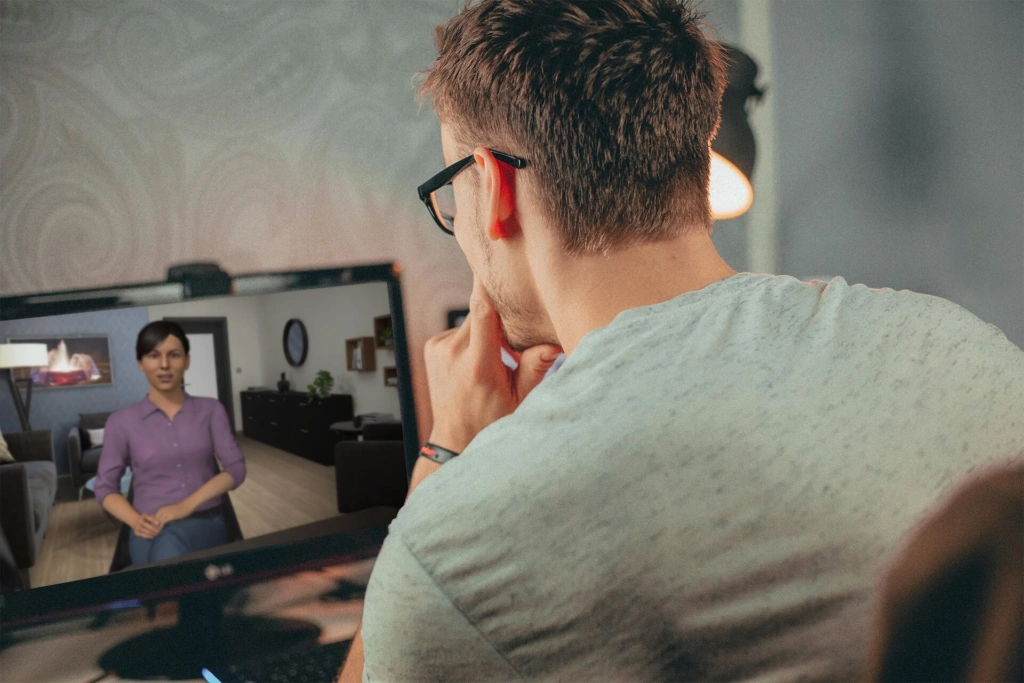
Picture a first-time manager preparing to deliver a disappointing performance review next Tuesday. Before she walks into that meeting, she can rehearse the conversation in a realistic scenario, with a realistic, emotionally responsive counterpart who pushes back, asks hard questions, and reacts in real time to what she actually says.
That’s what immersive leadership development looks like in practice. A place to work through the moments that matter before those moments are real, with a counterpart who responds dynamically rather than reading from a script.
And importantly, it doesn’t require a VR headset. Modern immersive platforms run through a standard browser on the devices your team already uses. No specialized hardware, no IT project, no training to train on the training.
Three things set immersive leadership training apart from passive formats.
Practice, not performance. Simulation is a place to get it wrong. Leaders can stumble through a tough conversation, see how it lands, and try it again with different words. That iterative loop isn’t something any real management relationship allows.
Feedback that’s actually about you. After a scenario, leaders don’t get a generic score. They get feedback calibrated to what they actually said: “you moved to the problem before acknowledging her perspective, which is why defensiveness came up so early.” That kind of specificity is what changes behavior.
Safety for the conversations that matter most. The moments that most shape a leader’s impact (delivering a PIP, handling someone in crisis, navigating a DEI confrontation) are exactly the ones nobody volunteers to practice in real life. Simulation makes those moments rehearsable, without the real-world cost of getting them wrong in the room.
Why Practice Is the Missing Ingredient
If you’ve ever worked hard to improve at a sport, an instrument, a pitch, you already know the shape of how it happens. You try. Something doesn’t work. Someone shows you what to adjust. You try again. That loop, repeated with focus over time, is how skill actually develops.
Psychologist Anders Ericsson called this deliberate practice. Decades of research shows that what separates the strongest performers in a field isn’t talent or years on the job. It’s the quality of the practice they put in: focused repetition, immediate feedback, and steadily increasing challenge.
Instead of anchoring in practice, traditional leadership training simply provides frameworks to read or videos to watch. Immersive simulation gives leaders a learning loop.
In addition to deliberate practice, the concept of behavioral rehearsal tells us that people consistently perform better in difficult conversations when they’ve experienced them before, even in a simulated version. Think of a job interview or important presentation you rehearsed out loud with a friend: going through the motions once relieves some of the pressure of the high-stakes moment. For a first-time manager facing their first performance review, that relief and confidence is worth a lot.
One more thing that consistently holds true: timing matters. Practice works better when it’s spread over time, not compressed into a single day. Leadership skills develop the same way most real skills do: through repetition, over time.
The takeaway is simple. If you want leaders to behave differently, they need to practice behaving differently. Immersive simulation is currently the only way to create that kind of deliberate practice at the scale an enterprise L&D program needs.
Where Interactive Leadership Training Delivers the Most Value
Immersive methods aren’t equally useful for every leadership skill. They earn their place in situations where the stakes are high, the emotions are real, and leaders rarely get to practice in safe conditions. Here’s where the investment pays back most.
| Leadership Scenario | Why Immersive Methods Work Here | What Leaders Actually Practice |
|---|---|---|
| Giving difficult feedback | The conversations managers avoid most are the ones they most need to practice | Sequencing, tone calibration, handling defensiveness in real time |
| Managing underperformance | High legal and relational sensitivity makes real-world practice risky | Documenting concerns verbally, maintaining the relationship, setting expectations clearly |
| Coaching a team member | Most managers default to directing; simulation exposes where coaching actually lives | Asking versus telling, listening cues, forward-focused language |
| Handling team conflict | Managers intervene inconsistently; practice builds the reflex | Neutrality, de-escalation, separating the process from the personalities |
| Leading through change | Ambiguity triggers anxiety, and anxious leaders hedge | Communicating uncertainty with confidence, meeting resistance without flinching |
| Interviewing and selection | Bias enters most in unstructured, informal conversations | Structured questioning, avoiding leading language, anchoring on evidence |
The thread running through every one of these is familiar. These are situations leaders can describe perfectly in a workshop and still handle poorly in the actual moment. Closing that gap is the whole point of immersive leadership development.
Building an Immersive Leadership Development Program That Sticks
Adopting immersive leadership development doesn’t require rebuilding your L&D stack. The strongest programs add simulation as a practice layer on top of the frameworks and content your organization already teaches. Here’s what that looks like in practice.
Step 1: Get specific about what good looks like. Broad goals like “improve feedback skills” are hard to build a scenario around. The more precise the target, the better the simulation can work. Instead of “deliver better feedback,” try “open with an observation before making an evaluation, and check for understanding before closing.” That’s something a scenario can rehearse, and something you can measure.
Step 2: Ground the scenarios in your organization. Generic scenarios produce generic results. The best programs use scenarios pulled from situations your leaders actually face, anchored in specific practice opportunities: your industry, your culture, your real organizational dynamics. The feedback conversation a healthcare L&D team rehearses looks different from the one a retail district manager works through. That specificity is what makes the practice translate back to the job.
Step 3: Build in repetition and progression. One session doesn’t change behavior. Practice distributed across weeks does. The strongest programs sequence scenarios from lower to higher stakes over time, so leaders build fluency against progressively harder moments, the way an athlete builds against progressively harder opponents.
Step 4: Measure what actually matters. Satisfaction surveys tell you whether the experience was enjoyable. They don’t tell you whether anyone got better. For immersive leadership development, the metrics worth tracking are behavioral. Are leaders applying what they rehearsed in their real team interactions? Are engagement, retention, and performance numbers moving downstream? Those are the results that make the case to the rest of the business.
Frequently Asked Questions About Immersive Leadership Development
What is immersive leadership development?
Immersive leadership development is a practice-based approach to building leadership skills. Instead of teaching leadership through lectures or videos, it puts leaders inside realistic scenarios where they can rehearse the hardest parts of the job: feedback conversations, conflict resolution, coaching, high-stakes communication. The practice is what shifts the behavior.
How is immersive leadership training different from role-playing?
Traditional role-play depends on finding a skilled partner, and it doesn’t scale past the room it’s happening in. Mursion’s simulations pair AI-powered avatars with live simulation specialists, so every participant gets the same challenging counterpart, the same quality of interaction, and behavioral data you can review afterward. Role-play produces an experience. Simulation produces a measurable outcome.
What leadership skills are best developed through immersive methods?
Interpersonal ones, above all. Feedback delivery. Difficult conversations. Conflict mediation. Coaching. Change communication. Anything with a strong emotional or situational component, where the right answer depends on how the other person responds in the moment, is where immersive practice earns its place.
Does immersive leadership development work for remote teams?
Yes. Modern simulation platforms run through a standard browser and require nothing beyond a computer and internet connection. That makes them especially well suited to distributed teams, and delivers the same program experience whether your leaders are logging in from Chicago, Mumbai, or São Paulo.
Request a demo to see how Mursion’s immersive leadership training works in practice.