James has been in their role for a few weeks when the email comes in.
A peer—Taylor, who’s been with the company for six years—has been shutting down ideas in meetings and refusing to consider new approaches.
James is frustrated, but hesitant. Taylor is experienced, respected, and difficult to challenge.
So instead of addressing it directly, James escalates it to you, their manager.
This is how most workplace conflict shows up: not as a dramatic confrontation, but as tension people aren’t sure how to handle.
Most managers don’t avoid conflict because of apathy. They avoid it because they’re not sure they’ll handle it well.
That hesitation is understandable. The conversations that come with team conflict, the ones where you have to address what’s really going on, are genuinely difficult. There’s no script. The stakes feel personal. And the risk of making things worse is real.
This guide covers the types of conflict your team will face, a step-by-step process for resolving them, and the skills that separate a conversation that helps from one that doesn’t.
What Is Team Conflict (and Why It’s Not Always a Problem)?
Most team conflicts follow recognizable patterns, once you know what to look for.
At the broadest level, conflict falls into two categories:
- Cognitive conflict is about the work: what to build, how to prioritize, and who owns which decision. Managed well, it generates better ideas and stronger decisions.
- Affective conflict is personal: hurt feelings, perceived slights, eroded trust. Left unaddressed, it damages trust, poisons culture, and drives good people out the door.
The goal isn’t to eliminate conflict from your team. It’s to keep the first kind productive and catch the second before it takes root.
Healthy Conflict vs. Unhealthy Conflict
| Healthy Conflict | Unhealthy Conflict |
| Debate about strategy, process, or priorities | Personal attacks or blame |
| Disagreement that leads to better decisions | Repeated grievances that never get resolved |
| Openly challenging ideas with respect | Avoidance and passive disengagement |
| Different perspectives aired and heard | Cliques, gossip, and exclusion |
| Resolved with a clear next step | Festering tension with no clear owner |
Task and process conflict
Task conflicts arise when people disagree about goals, priorities, or what success looks like. Process conflicts center on how the work gets done: who makes which decision, what the workflow looks like, and which system to use.
These are common in high-performing teams; they’re usually a sign that people care about the outcome. The risk is when task disagreement spills into frustration and becomes personal.
Example: Two engineers disagree about the architecture of a new feature. Neither is wrong. They have different risk tolerances and different views on future scalability.
Relationship and interpersonal conflict
Relationship conflict occurs when the friction is about people, not work. It often starts small, a comment that landed wrong, a credit that wasn’t given, a communication style that reads as dismissive. Small grievances compound over time.
This type of conflict is the most damaging and the hardest to resolve, because both parties are often unaware of how their own behavior has contributed to it.
Example: A team member feels consistently interrupted in meetings by a senior colleague. They haven’t raised it directly. The resentment has been building for months.
Status and values conflict
Status conflicts involve competition for authority, recognition, or resources. Value conflicts arise when people have fundamentally different views about how work should be done, or what “good enough” looks like.
Example: A manager who prizes speed and a team member who prizes quality can’t agree on when work is ready to ship. Neither is being irrational. They’re operating from different definitions of excellence.
In practice, these categories often blur together. What starts as a disagreement about the work can quickly become personal if it isn’t addressed early.
The shift from task conflict to interpersonal tension is where most managers struggle, and where conversations become significantly harder to navigate.
How to Resolve Conflict in the Workplace: A Step-by-Step Process
There’s no single script that resolves every conflict, but there are skills that reliably drive better outcomes and solutions. . The challenge isn’t knowing what to do. Instead, it’s actually applying the right skills in a live conversation, when emotions are high and the outcome is uncertain.
Managers who work through conflict systematically, even when it’s uncomfortable, consistently get better outcomes than those who improvise or avoid.
Step 1: Diagnose before you do anything else
The most common mistake is rushing to solve before fully understanding the problem. Before calling anyone into a conversation, ask yourself: Is this fundamentally about the work, or about the people?
Talk to each party separately. Use open questions: “Help me understand what happened from your point of view.” “What would a good outcome look like for you?”
Then try to produce a one-sentence problem statement you could read to both parties without either one objecting. If you can’t do that yet, you don’t fully understand the conflict.
Step 2: Set the conditions before the conversation starts
Set a ground rule that one person speaks at a time. Make it explicit that the goal isn’t to determine who was right, but to understand what happened and agree on what comes next.
Psychological safety is what makes honest conversation possible. If either party believes that being honest will damage their standing, they won’t be honest. Managers build that safety over time by demonstrating consistently that raising problems is welcome, not risky.
This is also the point where many conversations go off track, not because the manager lacks a framework, but because the pressure of the moment makes it difficult to stay grounded and intentional.
Step 3: Listen first, solve second
This is the step most managers rush. Active listening in a conflict conversation means more than staying quiet while the other person speaks. It means paraphrasing what you heard, checking your understanding before offering any interpretation, and resisting the urge to problem-solve while someone is still talking.
A practical technique: after each person shares, summarize what you heard and ask, “Did I get that right?” This slows the conversation down, which nearly always reduces defensiveness. People who feel genuinely heard are far more willing to consider that the other person might have a point.
What This Looks Like in a Real Conversation
Recall the conflict between James and Taylor, and imagine that you’re their manager helping James navigate this moment.
Manager: “Before we jump into solutions, I want to understand how you experienced what happened in the meeting.”
James: “I felt like my input was dismissed before I could explain it.”
Manager: “Feeling cut off before you could fully share your thinking. Did I get that right?”
This kind of exchange may seem simple, but it reflects several critical skills happening at once:
- listening without interrupting
- validating perspective without agreeing
- slowing the conversation down to reduce defensiveness
These are the moments where conflict conversations either open up or shut down.
Step 4: Separate the people from the problem
The core principle is simple: describe behaviors and their impact, not character or intent.
“You never listen to me” is a character judgment. “In our last three meetings, I felt cut off before I finished making my point” describes a specific, observable behavior and its effect. The first triggers defensiveness. The second opens a conversation.
Guide both parties to move from positions (“I need X”) to interests (“What I actually care about is Y”). Two people who appear to want opposite things often find they share a core interest once the positional language is set aside.
Step 5: Build and commit to a specific action plan
Resolution without follow-through isn’t resolution. Once the conversation surfaces a path forward, document it: specific next steps, named owners, and a deadline for each.
Then schedule a follow-up conversation within two weeks. A conflict that looks resolved in a meeting can re-emerge once people return to day-to-day pressures. The follow-up signals that this matters and catches any backsliding before it becomes entrenched.
What Conflict Resolution Skills Do Managers Actually Need?
Understanding a framework and being able to use it under pressure are two very different things. The real challenge is staying composed when emotions run high, listening when you’d rather push back, and keeping the conversation productive when it starts to drift.
These are behavioral skills. And like any behavioral skill, they’re honed through practice.
Constructive dialogue: engaging in honest, respectful discussions that explore different perspectives without escalating tension
Effective questioning: asking unbiased, open-ended questions that surface what’s actually driving the conflict
Emotional regulation: staying composed enough to keep the conversation productive, even when it becomes uncomfortable
Autonomy support: empowering individuals to take ownership of resolving the conflict themselves, rather than stepping in to solve it
Why most conflict training doesn’t stick
Most organizations address this through workshops, e-learning, or classroom instruction. These build awareness, managers leave with a better framework and a clearer sense of what good looks like. What they don’t build is fluency.
A manager who has completed a conflict resolution workshop knows the steps, but they haven’t felt the pressure of a conversation going sideways, made a real-time decision under that pressure, and had to live with the result.
Traditional role-play gets you closer, but the scenarios are often artificial, and the feedback loop is slow.
Practice closes the gap that reading can’t
Most managers only get one chance to handle a conflict conversation – live in the moment.
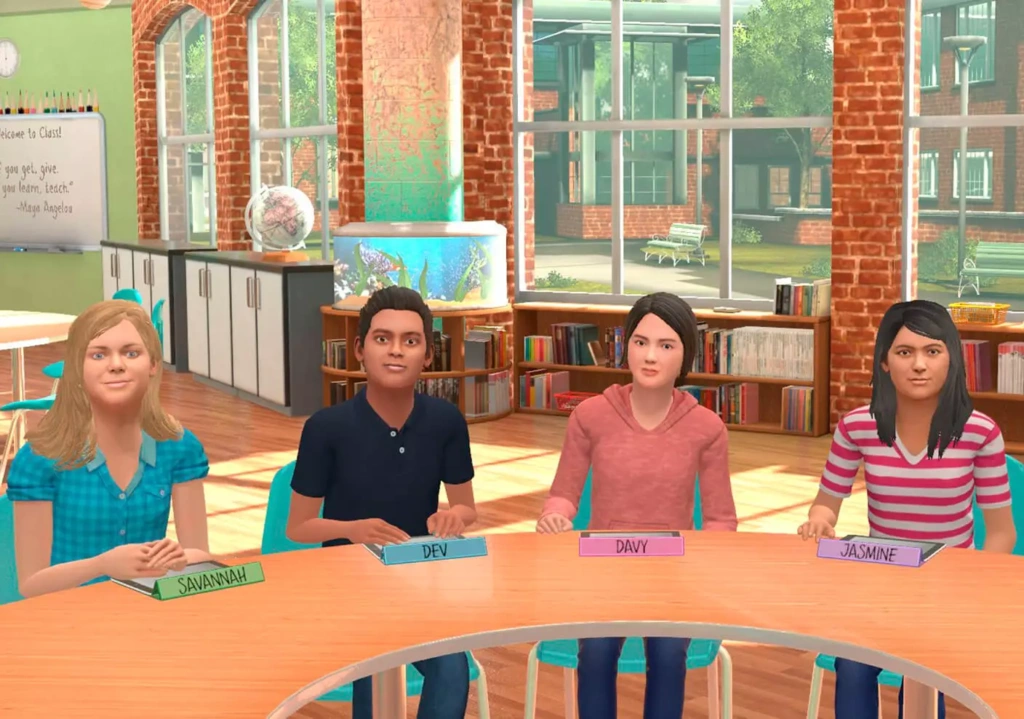
In Mursion simulations, you can practice scenarios like:
- coaching a new team member to confidently address tension with a more tenured colleague
- navigating resistance from influential team members during change
- giving feedback to a high performer whose behavior is impacting the team
Each scenario reflects a real leadership moment, where the conversation can shift based on how AI-powered avatars respond dynamically to what you say and how you say it.
These aren’t scripted role plays. The interaction evolves in real time, allowing managers to try an approach, see the outcome, and adjust.
That’s what builds fluency, not just understanding.
Over 80% of Mursion users report improved confidence in difficult conversations after simulation practice, and more than 90% rate the scenarios as authentic to their role.
[See how Mursion lets managers practice conflict conversations before they matter]
Managing Conflict in Remote and Hybrid Teams
Conflict in remote and hybrid environments follows the same patterns as in-person conflict, but it escalates faster and is harder to catch early. The informal signals that reveal friction (body language, tone, the quiet tension in a room) are absent or filtered out.
Text and chat are the primary accelerants. A message that may have landed fine in person reads as dismissive in Slack. An email written in frustration is now part of the record. When the tone is ambiguous, people fill the gap with the worst possible interpretation, and that assumption quietly becomes the source of the conflict.
Practical guidance for remote and hybrid teams:
- Move conflict conversations off text. A conflict that started in Slack needs to be resolved on video or in person. Written exchanges escalate disagreements; conversations resolve them.
- Make expectations explicit and visible. Remote team members can’t observe the informal norms that govern in-office teams. Write down the operating agreements that in-office teams leave unstated.
- Schedule a structured team connection. When conflict does arise, teams that actually know each other handle it better, as there’s more goodwill to draw on.
- Don’t let async communication substitute for difficult conversations. If two people are avoiding each other in Slack, that’s not a resolution. It’s avoidance.
FAQs: Managing Team Conflict
What does team conflict actually cost a business?
According to a CPP Global Human Capital Report, US employees spend an average of 2.8 hours per week dealing with conflict, translating to an estimated $359 billion in paid hours annually.
What are the most common causes of team conflict in the workplace?
The most common causes are unclear roles and responsibilities, competing priorities, communication breakdowns, and personality or working-style differences. Most destructive conflicts start as disagreements over tasks that escalate into relationship problems when they’re not addressed early enough.
Why do managers struggle with conflict conversations even when they understand the theory?
Because knowing what to do and being able to do it under pressure are different skills. The gap between employer confidence and actual outcomes tells the story clearly. According to CIPD’s 2024 research, 70% of employers believe they have effective procedures for resolving conflict, but only 36% of employees who experienced conflict say it was fully resolved. Managers are on the front line of conflict resolution, often without the skills or practice to handle it.
Can simulation training help managers become better at conflict resolution?
Yes. Most managers have a reasonable sense of what they should do in a conflict conversation. The problem is doing it in real time, when someone is upset, the pressure is on, and the instinct is to shut down or escalate. Simulation-based practice, like the environments Mursion provides, lets managers rehearse those moments in a realistic setting, get feedback on what worked and what didn’t, and build the kind of fluency that holds up under pressure.
The Next Conflict Isn’t the Problem. Being Unprepared Is
Every leader will face this moment: a conversation they know they need to have, but aren’t sure how it will go. Managing conflict well is one of the most meaningful things a leader can do for their team, and one of the hardest to get right.
The difference isn’t who understands the framework.
It’s who has practiced the conversation before they’re in it.
This guide gives you the structure.
What builds the skill is putting it into practice before the next difficult conversation lands on your desk. The managers who handle it best aren’t necessarily more confident by nature. They’ve just had more chances to rehearse.
This guide gives you the framework. What builds the actual skill is putting it into practice before the next difficult conversation lands on your desk.